|
Selected Reviews
& Notes
For Selected Reviews & Notes in Hebrew 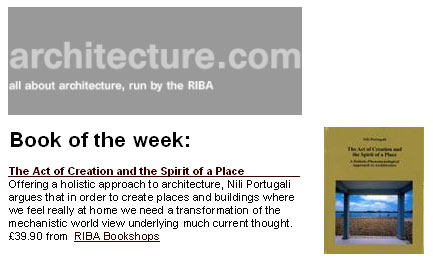 **
Michael W. Mehaffy / URBAN
DESIGN International
(2007) 12, Palgrave Macmillan Journal
In her introductory biographical note, architect Nili Portugali describes her early and unsatisfactory encounter with the quantitative methodologies of late 1960s' architecture and planning…. hers is not a work of philosophy, but a case study of a particular approach to architecture, and the real aim is to present the work and discuss its evolution. She does this in great detail. Indeed, next to the verbiage of many architectural monographs, hers is clear enough….. Drawing on analogies to Shaker buildings, Buddhist philosophy and other sources, she describes the fundamental difference between collections and assemblies of fragmented parts, and the process of differentiation….This notion of differentiating from an existing condition – of transforming an existing whole – is key to Portugali's design method… Portugali lays out a remarkably diverse set of projects: public buildings, mixed-use commercial projects, private houses….. It does not refer to any particular style, nor does it include the mix of stylistic elements that architectural critics love to hate – the dreaded 'pastiche'….And yet, neither is it obsessed with invention and constant newness. There is an ordinariness about it, a familiarity, and yet a sense of uniqueness, striking beauty and dignity too. It does not seem too concerned with being 'of its time', date-stamped as fashionably current….. Portugali notes that she does not try to reconstruct the past, nor does she try to avoid re-creating it. Rather, she simply follows the patterns that are appropriate for a site and context, which are often the same ones that have been appropriate in the past, and are likely to be appropriate in the future. …… This is Portugali's… humanist design philosophy: insistent that technology, of whatever time and place, must above all be the servant of human well-being…. There is in this sense a universality to Portugali's work that is in one sense unremarkable and in another, in the context of so much contemporary architecture, radical and revolutionary…. Portugali's quiet revolution may be the one that passes the ultimate test of time. **
John Lobell / Journal of
Architectural
Education (JAE), Volume 62:2, 2008, Wiley / Blackwell
"She is an Architect more than a theorist. This is an important distinction because what she is presenting in the book is a codified methodology derived from her architectural practice. Portugali, like Alexander believes in universals in the human psyche because, as she writes, ‘‘there is an ultimate truth common to us all as human beings”…… If Portugali’s holistic-phenomenological approach to architecture is not new, it is nonetheless refreshing and her book will be of great value to anyone who believes that what ever else buildings should mean or be or do, they should at the very least satisfy us as human." **
Gilad Duvshani / Books Supplement, Ha'aretz
December 13, 2006
"It is not every day that a book is published which describes the world view of an Israeli architect with a fascinating body of work and a structured thesis about how architecture should be practiced here, Such is Nili Portugali’s book..." For
Full Text (Hebrew)
**
'Arquitectura' magazine, 1.3.2007
The Art of Creation and the Spirit of Place (A Arte da Criação e o Espírito do Lugar), o livro em que Nili Portugali desenvolve, com o apoio de quase 600 ilustrações, a sua concepção de arquitectura holística, foi publicado pela editora Axel-Menges, de Estugarda e Londres, e declarado 'Livro da Semana' na categoria de livros de arquitectura, pela Associação Britânica de Arquitectos. For
Full Text (Portuguese)
**
**
|
Cahill, Jeremiah / Architecure is a social art form
Antonio J.Villarreal / More than an intersection
McNab, Adele / Creative spaces: The application of arts and crafts in contemporary architecture
Banerjee, Shubhendu / Appropriate vocabulary for a Hindu Temple design in Auckland
Shah, Rinkle / A phenomenological study of contemplative experiences: Implications for interior design
Monica, Harvey / In the meantime... investigating the non-place
Eva Marie, Mercurio / Community Wellness Center: Providence, Rhode Island
Stephen Jesse, Ward / Making sense of monumentality: A multisensory archaeological approach to Hawaiian ritual architecture
Emma Elizabeth, Crenshaw / Transforming Together: Reconsidering Adaptive Reuse
Anna, Peterson / Picturing Meaning: Icelandic Students' Perceptions of Their Purpose-built School
David, Seamon / winter/spring 2017 issue of Environmental & Architectural Phenomenology
Juval, Portugali (Page 130) / Visual and Spatial Reasoning for Design Creativity edited by John S. Geroh